The Fort Hood killer deserves punishment for the Fort Hood massacre. Broadcasting his execution, however, would have turned justice into...
Read More
International-News
June 2016, Brexit Referendum Result Redefines the UK and the EU
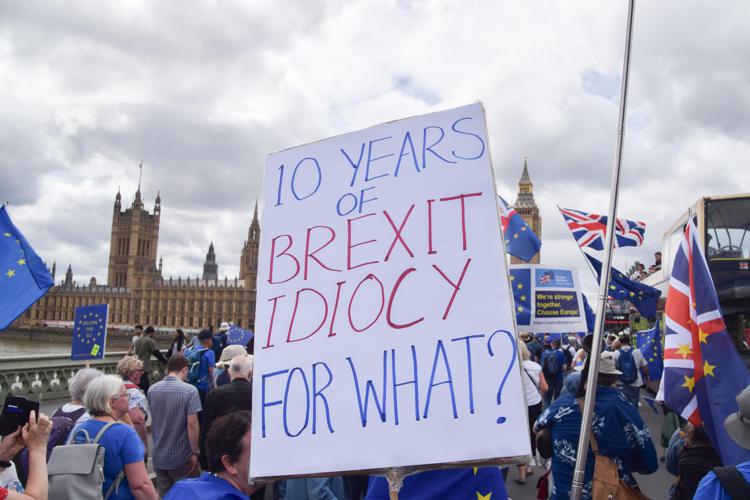
On June 24, 2016, the United Kingdom voted to leave the European Union, triggering a historic political, economic, and institutional rupture across Europe
In the early hours of June 24, 2016, the political map of Europe shifted in a way few had anticipated. As vote counts from across the United Kingdom confirmed a majority for Leave, it became clear that the Brexit referendum result had delivered a decisive break: the UK had chosen to exit the European Union.
The reaction was immediate. Nigel Farage, a central figure in the pro-Brexit campaign, marked the moment in London, while in Brussels officials within the European Commission were confronted with the political shock of a member state preparing to leave the Union for the first time in its history. The decision reduced the EU from 28 to 27 member states, removing around 66 million citizens and approximately 13% of its population.
The referendum held on June 23, 2016 produced a narrow but clear outcome. The Leave campaign secured 51.9% of the vote, compared to 48.1% for Remain. Prime Minister David Cameron, who had called the referendum to settle internal divisions within the Conservative Party, suffered a strategic defeat. The following day he announced his resignation, which took effect on July 13, 2016.
Financial markets reacted sharply. The British pound dropped to levels not seen since 1985 against the U.S. dollar, while European equity markets plunged. In Milan, the FTSE MIB fell by more than 12%, marking one of the steepest declines in its history.
Pre-referendum negotiations that had granted the UK a special status within the EU framework collapsed in relevance after the vote. In Brussels, the presidents of the main European institutions held an emergency meeting and issued a joint declaration affirming unity among the remaining 27 member states and reaffirming the Union’s political and economic continuity.
European leaders described the situation as unprecedented but stressed coordinated action. Then-European Commission President Jean-Claude Juncker also called for clear political signals from France and Germany regarding the future of the Union after the departure of one of its largest economies and one of its two nuclear powers.
Although triggered in 2016, Brexit unfolded over several years. The most complex issue proved to be Northern Ireland, where the post-1998 peace architecture depended on the absence of a hard border with the Republic of Ireland under EU membership rules.
Negotiations extended for years and produced multiple frameworks aimed at avoiding the return of a physical border. The withdrawal agreement was finalized in October 2019, allowing the UK to formally leave the EU on January 31, 2020. A trade agreement followed in late 2020, reached just before the end of the transition period during the COVID-19 pandemic.
The Irish border issue remained the most sensitive element. The 2020 protocol effectively moved customs controls to the Irish Sea, creating political and logistical tensions. This arrangement was later revised under the Windsor Framework in 2023, negotiated under Prime Minister Rishi Sunak, introducing a system of differentiated trade lanes implemented in 2024.
Over time, Brexit has been widely assessed as a “lose-lose” process. The United Kingdom entered a prolonged phase of political instability, cycling through multiple prime ministers, from Theresa May to Boris Johnson, Liz Truss, Rishi Sunak, and later Keir Starmer.
Economic analyses have linked the Brexit referendum result to a long-term decline in UK output, investment, employment, and productivity, driven largely by structural uncertainty.
For the European Union, the departure of the United Kingdom did not produce the expected acceleration toward deeper integration. Financial consolidation in Europe lagged behind expectations, while London retained its position as a global financial hub.
Migration patterns also shifted. EU migration to the UK declined after Brexit, while non-EU migration increased, partially offsetting the change. By 2025, net migration from the EU had turned negative, reflecting the new post-Brexit equilibrium.
In the following years, broader geopolitical developments — including Russia’s war in Ukraine and shifting transatlantic relations — contributed to a gradual recalibration between London and Brussels. While institutional separation remains, political cooperation has become more pragmatic in selected areas.
THE LATEST NEWS

Trump Says Iran War Could End “Very Soon” as Pentagon Weighs MOAB Option
15 October 2026
The president says the conflict would end whenever he decides, while reports indicate U.S. military planners have examined scenarios involving...
Read More

Katie Zacharia’s Lawyer Credentials Questioned After White House Appointment
15 October 2026
Wall Street Journal report finds the newly appointed White House press secretary was never licensed to practice law in the...
Read More

Trump Can’t Avoid Looking Ridiculous: Shares AI Video After Man Is Mauled by Tiger
14 October 2026
The president's latest social media stunt has drawn outrage from the family of a young British man killed by a...
Read More

Iran Woman Sentenced to Death Over Social Media Post, Rights Groups Warn
14 October 2026
Human rights organizations are raising alarm over what they describe as an accelerating use of capital punishment to silence dissent...
Read More

Trump Media Ban Blocked as Judge Restores CNN, Politico and MSNBC Access
14 October 2026
A federal judge found little evidence that national security concerns were behind the White House decision to revoke access credentials...
Read More
(Photo: © AndKronos)