Delays and cancellations spread across key airports in New York, New Jersey, Boston and Philadelphia after a construction crew accidentally...
Read More
International-News
Russia prepares for possible NATO conflict in Northern Europe
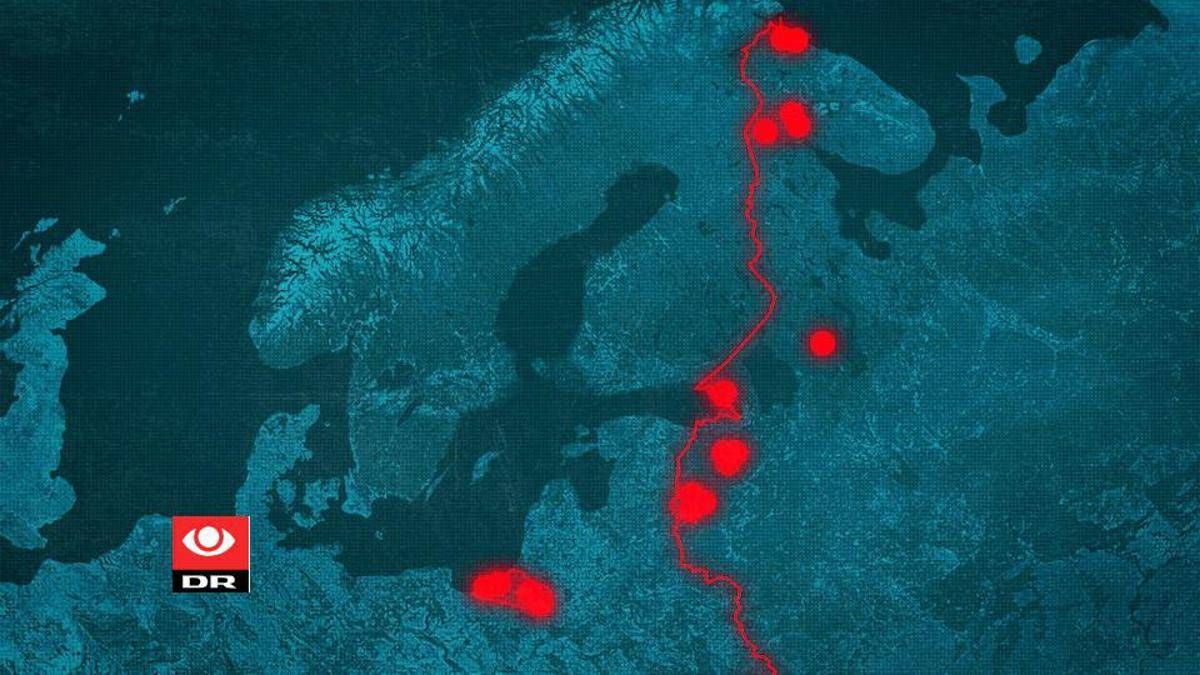
A joint Nordic investigation points to a structural military buildup along Russia’s northern frontier, with a potential one-to-three-year window of heightened risk after the war in Ukraine
Russia is not only preparing to sustain its war in Ukraine. It is also restructuring its military posture along the northern European frontier, from the Arctic to the Baltic, in what intelligence officials and analysts describe as a potential setup for a large-scale confrontation with NATO.
This is the central finding of “Krigsplan Europa” (“War Plan Europe”), a joint investigation by Danish public broadcaster DR with Sweden’s SVT, Norway’s NRK, and Estonia’s Delfi. The report documents new bases, expanded infrastructure, the reconstitution of large military units, and a shift in force structure from brigades to divisions—changes consistent with long-duration, high-intensity warfare rather than limited defensive measures.
Timing is a critical concern. Sources cited by DR identify the next one to three years as the most dangerous phase for Europe, particularly in the period immediately following a potential end or freeze of the war in Ukraine. In that scenario, Russia could field battle-hardened troops, sustain a war-driven economy, and mobilize forces more rapidly than European countries currently rebuilding their defenses.
The investigation draws on more than 18 months of reporting and over 25 in-depth interviews with Nordic intelligence chiefs, NATO officers, and sources with access to classified information on Russian military activity. It is supported by satellite imagery analyzed by former Finnish military intelligence officer Marko Eklund, confidential NATO documents on war scenarios, and threat assessments published by seven regional intelligence agencies.
The conclusion is consistent across sources: Russia is reinforcing its entire northern NATO border, from Norway and Finland to Lithuania. NATO’s expansion to include Finland in 2023 and Sweden in 2024 has transformed the region into a strategic frontline, prompting what the investigation describes as a structural military response from Moscow.
A key shift involves the type of forces being deployed. Russian units organized as brigades—typically around 4,000 troops—are being expanded into divisions of up to 10,000 soldiers. Unlike brigades, which are lighter and more flexible, divisions are designed for sustained combat operations, with integrated artillery, logistics, and heavy support.
According to Eklund, once operations in Ukraine conclude, Russia could deploy approximately 115,000 troops along its northern European borders. This force could be rapidly reinforced by hundreds of thousands of veterans redeployed from other parts of the country.
Swedish military intelligence chief General Thomas Nilsson, commenting on satellite imagery, said the buildup is not symbolic: it reflects preparation for a future large-scale conflict with NATO.
At the core of the assessment is what intelligence officials describe as a “window of vulnerability.” The most dangerous period may emerge not when Russia reaches peak military strength, but when its capabilities temporarily outpace Europe’s slower rearmament process. One Nordic intelligence source cited in the investigation noted that Moscow could act when its adversaries are still unprepared.
Norwegian Armed Forces chief General Eirik Kristoffersen identified a two-to-three-year horizon as the worst-case scenario, pointing to sustained high levels of Russian military production. Until Europe significantly increases output of ammunition, defense systems, ground forces, air capabilities, and advanced technologies, Russia may retain an operational advantage.
The investigation emphasizes that it does not predict an imminent attack. Instead, it highlights a convergence of military developments and intelligence assessments suggesting that Europe could soon face its most exposed phase in a broader strategic transition.
The region itself has undergone a profound shift. NATO’s enlargement has extended its direct border with Russia, bringing areas such as the Kola Peninsula, the Baltic Sea, and the St. Petersburg region back to the center of military planning. For Moscow, this ტერიტry is vital for Arctic access, naval assets, and strategic connectivity. For countries like Finland, Estonia, Latvia, Lithuania, Poland, Sweden, and Norway, the threat is defined by geography rather than theory.
Security agencies in the region consider the potential redeployment of Russian veterans from Ukraine to the northern and Baltic fronts as a key variable in the coming years. This does not make conflict inevitable, but it raises the likelihood of increased military pressure, coercion, or—in a worst-case scenario—direct aggression.
The investigation also underscores weaknesses in Europe’s response. A senior NATO officer cited gaps in conventional forces across land, sea, and air domains, limited access to space-based capabilities, shortages of unmanned systems, and insufficient protection of critical infrastructure.
Air defense is identified as the most significant vulnerability. In a modern conflict, airports, ports, energy grids, rail networks, digital nodes, and military bases would be primary targets. Despite recent improvements, European air defense remains fragmented and potentially inadequate for a multi-front, high-intensity war.
The issue is closely tied to the role of the United States. Washington has repeatedly signaled that Europe must take on a greater share of its own security. Even without a U.S. withdrawal from NATO, simultaneous commitments in other regions—particularly the Indo-Pacific—could limit American availability.
The broader analytical context aligns with findings from institutions monitoring military trends. These include sustained Russian defense spending, the reconstitution of units oriented toward the northern flank, and the resilience of Russia’s war economy despite sanctions.
Russia has rejected the investigation’s conclusions. Its ambassador to Denmark, Vladimir Barbin, called claims of a planned attack on NATO countries “a lie,” arguing they are used to justify increased military spending in Europe. Russia’s Defense and Foreign Ministries did not respond to requests for comment.
The denial does not alter the underlying military developments described. The investigation does not assert that an attack has been decided or scheduled. It documents a shift in capabilities, posture, and strategic intent as interpreted by multiple intelligence and military sources.
Danish General Brian Nissen, who would command up to 150,000 troops in defense of the Baltic region and parts of Poland in a conflict scenario, described a potential war with Russia as multidimensional—spanning land, air, sea, space, and cyberspace.
In recent years, particularly after the invasion of Ukraine, the perception of Russia across Northern and Eastern Europe has changed. It is no longer seen solely as a source of diplomatic pressure or hybrid threats, but as a potential conventional military adversary.
Deterrence remains the objective. But its credibility depends on tangible capabilities: rapid response, sufficient stockpiles, industrial production, integrated air defense, intelligence, logistics, and political cohesion.
The investigation’s most consequential message concerns Europe itself. While Russia appears to be adapting to a prolonged confrontation, Europe is still translating political awareness into military capacity. The gap between these timelines defines the current vulnerability.
For decades, European security relied on technological superiority, U.S. protection, and the assumption that large-scale conventional war on the continent was unlikely. The war in Ukraine has already challenged that assumption. The evolving situation along the northern and Baltic front raises a new question: what happens if Russia tests NATO cohesion where Europe’s rearmament is not yet complete?
THE LATEST NEWS

UK Air Traffic Control Fault Disrupts Flights Again, Sparking Fresh Criticism
21 September 2026
Hundreds of flights were affected across the United Kingdom after a technical issue at the country's air traffic control network,...
Read More
Ibogaine Research Fuels Hope for Addiction Care, but Experts Warn of Fatal Risks
21 September 2026
As interest in psychedelic therapies spreads beyond research settings, specialists caution that ibogaine remains experimental and may pose life-threatening cardiac...
Read More

Trump White House Media Ban Triggers Lawsuit From CNN, Politico, and MS NOW
21 September 2026
The three news organizations accuse the administration of violating press freedom after their reporters were barred from the White House...
Read More

Earl Spencer Says Diana’s Story Is Repeating Itself in Coverage of Harry and Meghan
21 September 2026
The brother of Princess Diana has drawn a direct comparison between the treatment she endured from the press and the...
Read More

Trump Signals Imminent Decision on the US-Iran Conflict
20 September 2026
The U.S. president says he is in a "decision-making phase" as tensions across the Middle East rise, while leaving the...
Read More

(Photo: © AndKronos)