
International-News
Foreign Newspapers Cast Trump’s Midterm Defeat as a Rebuke
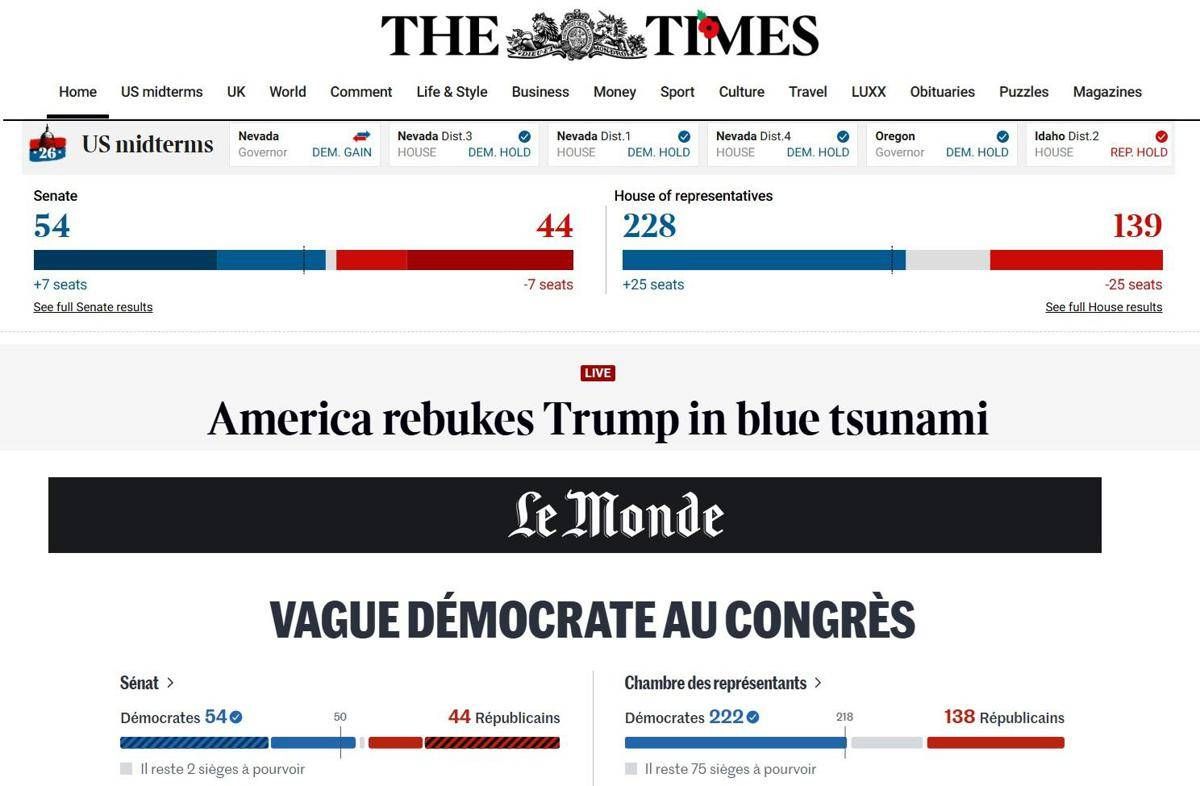
From The Guardian to Le Monde, international coverage focuses on the Democrats’ takeover of Congress, the cost of living and the fallout from Trump’s policies
The verdict from the international press is strikingly consistent: Donald Trump’s Republican Party has suffered a political collapse, and the Democrats’ capture of both chambers of Congress amounts to a sweeping rejection of the president’s agenda. Across Britain, Spain, Germany and France, newspapers have reached for images of waves, floods and tsunamis to convey the scale of the Democratic victory in the 2026 midterm elections.
But the coverage goes beyond the election map. Several publications portray the result as a test of Trump’s political authority, while others focus on the economic and foreign-policy grievances that may have driven voters away from his party. The common thread is a president facing a far more hostile Congress two years before the end of his term.
In France, Le Monde offers one of the sharpest readings of the result. Its headline, “A Democratic wave in Congress,” describes Trump’s defeat as historic, stretching from Texas to Michigan. The newspaper links the Republican losses to the president’s and his administration’s approach to the war in Iran against Israel, what it calls institutionalized corruption, and the failure to address voters’ most immediate concerns. Chief among them, it argues, is the cost of living.
Le Figaro also frames the outcome as a major setback for Trump, describing a Democratic wave that has swept through Congress. The newspaper emphasizes the scale of the victory: Democrats have secured majorities in both chambers, a shift it says would have been difficult to imagine just a year ago. The result, in its assessment, opens a period of uncertainty for a president with two years left in the White House.
British newspapers focus on the direct political message sent by voters. The Guardian says Americans have punished Trump by handing Democrats control of Congress, highlighting victories in Senate races across Michigan, Texas, Iowa, Kansas, North Carolina, South Carolina and Ohio. The Financial Times describes a “blue wave” sweeping the country and a severe defeat for Republicans, with losses extending from Texas to Georgia.
The Times adopts an even more dramatic image, declaring that America has rejected Trump in a “blue tsunami.” Its coverage also notes the president’s insistence that he will accept the midterm results, despite the Democratic takeover of both the House and Senate.
In Spain, El Mundo puts the Democratic victory under the label of a “blue wave,” pointing in particular to the party’s gains in Texas and Kansas. It also reports the White House’s attempt to distance Trump from the Republican defeats, arguing that the president had promoted many candidates more effectively than they had campaigned for themselves and stressing that he had not personally been on the ballot.
El País describes the outcome as a political upheaval and a major blow to Trump. Its account highlights Democratic victories in traditionally Republican territory, including Texas, Kansas, Iowa and South Carolina. It also singles out Abdul El-Sayed’s Senate victory in Michigan, describing him as the first Muslim elected to the upper chamber. The newspaper notes that Trump has acknowledged the defeat and said he would accept the results.
German coverage places greater emphasis on the president’s response and the prospect of a new relationship with Congress. Bild focuses on Trump’s comments to Politico, including his statement that he does not want to spend the next two years vetoing everything. The newspaper describes his willingness to cooperate with Democrats as an unusually conciliatory tone from the president.
The Frankfurter Allgemeine Zeitung chooses a different metaphor: Trump, it says, had anticipated a blue wave, but what arrived was a tsunami. Its analysis calls the election another pivotal moment for the United States and argues that the president bears responsibility for his party’s defeat.
Across the international headlines, the Democratic victory is presented not simply as a change in congressional control but as a direct challenge to Trump’s political leadership. The explanations differ, from economic frustration to foreign policy and the conduct of his administration, but the scale of the Republican setback dominates the coverage.
(Photo: © AndKronos)


Accordo Electrolux, dimezzati gli esuberi: 902 uscite volontarie
Salvi gli stabilimenti italiani, oltre 100 milioni di investimenti e continuità produttiva. A Cerreto d’Esi scongiurata la chiusura Da 1.719...

Musetti domina Zverev: 7-6, 6-2 contro il nuovo numero 1
Dopo un primo set combattuto, il toscano prende il controllo della partita e chiude in un’ora e 42 minuti Alexander...
Foreign Newspapers Cast Trump’s Midterm Defeat as a Rebuke
From The Guardian to Le Monde, international coverage focuses on the Democrats’ takeover of Congress, the cost of living and...

Addio a Tinto Brass, il regista che fece dell’eros il suo cinema
Aveva 93 anni. Dagli esordi anticonformisti a «La chiave», una carriera costruita sfidando censure, convenzioni e tabù Tinto Brass è...

Attacchi hacker ai supermercati, gruppi filorussi in azione
Il gruppo filorusso NoName057(16), insieme a Zpentest, rivendica le intrusioni in diversi Paesi. In Italia il governo esclude per ora...


Crans-Montana, la Svizzera pagherà le cure dei giovani italiani feriti
Il ministro degli Esteri Ignazio Cassis ha comunicato la decisione ad Antonio Tajani. Giorgia Meloni accoglie con soddisfazione la rinuncia...

Democrats Win Congress in 2026 Midterms, Delivering a Stunning Rebuke to Trump
Democrats capture both the House and Senate, opening the way for aggressive congressional oversight of the administration. Trump alternates promises...

Trump torna a minacciare l’Iran: «Molti vogliono un colpo pesante»
Dopo la sconfitta alle elezioni di midterm, il presidente americano non esclude nuove operazioni militari contro Teheran. Per ora può...

Israele, solita storia: Ben Gvir denuncia elezioni rubate e chiede arresti
Il ministro della Sicurezza nazionale invoca l’arresto dei leader dei partiti arabi e lo stop alla certificazione dei risultati elettorali,...

Titolo: Alluvione di Firenze, 60 anni fa la città sommersa dall’Arno
Il 4 novembre 1966 la piena devastò Firenze e gran parte della Toscana, provocando vittime e danni enormi al patrimonio...

Dai feudi repubblicani al Congresso, i giornali Usa celebrano l’onda blu
Il Washington Post parla di democratici al comando, mentre il New York Post evidenzia la riconquista del Senato dopo le...

Midterm 2026, i democratici conquistano il Congresso: Trump sconfitto
La maggioranza passa ai dem sia alla Camera sia al Senato. Hakeem Jeffries potrà guidare il controllo parlamentare sull’amministrazione repubblicana....


Midterm Voters Turn Election Into a Referendum on Trump, NBC Exit Poll Finds
Economic anxiety and frustration over persistent inflation helped shape the electorate, with a striking share of voters casting their ballots...

Garlasco, Sempio prepara la prima mossa: la difesa punta sulla Consulta
Gli avvocati contestano la possibilità di celebrare un nuovo processo per l’omicidio di Chiara Poggi mentre Alberto Stasi è ancora...


Wall Street Drifts Into Midterm Night as Investors Await Clarity
A late-session push in technology shares lifted the Nasdaq and helped the broader market finish higher, but investors remained reluctant...


CNN Voter Poll Signals Mounting Backlash Against Trump’s Leadership
A sweeping voter survey conducted alongside the midterm elections paints a bleak picture for the president, with widespread dissatisfaction over...
You must be logged in to post a comment Login