
International-News
SpaceX Starship Recovery Marks a Breakthrough in Reusable Rockets
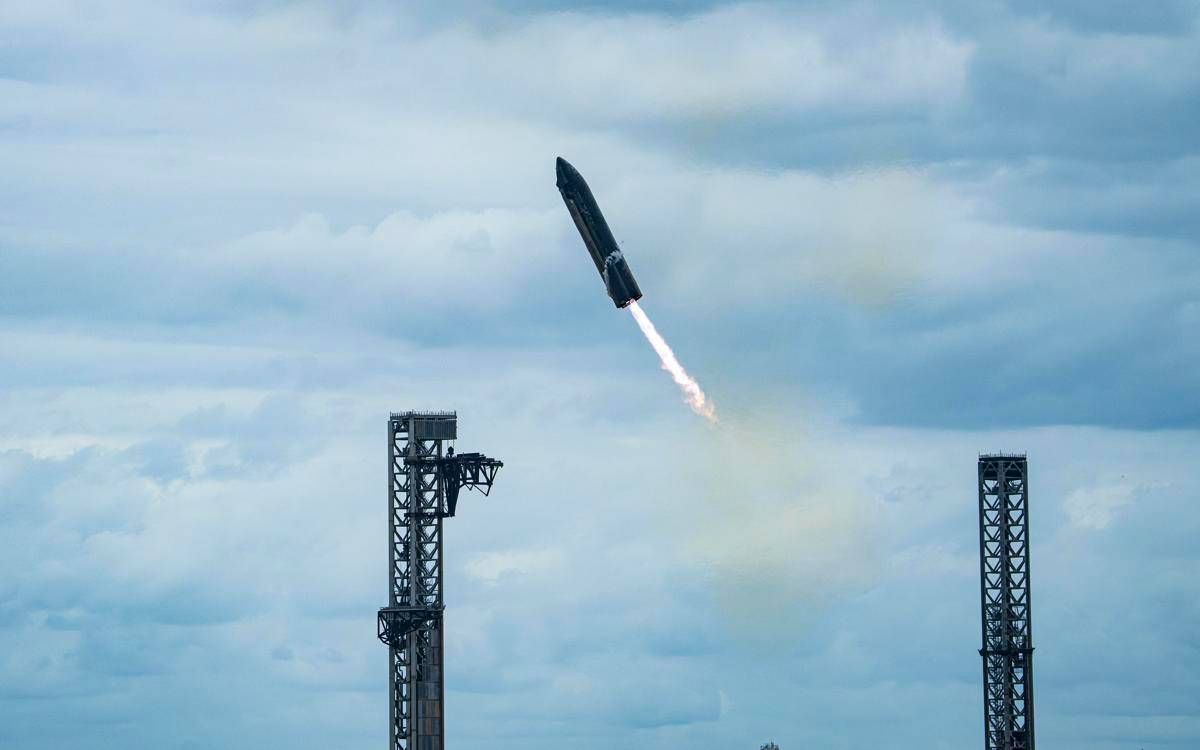
The spacecraft completed a 22-hour test flight, deployed 26 Starlink satellites and returned to Texas, where the company’s launch tower caught it in a first for the program
For the first time, SpaceX has brought its Starship spacecraft back to Earth and caught it in midair with the giant steel arms of its launch tower, marking a major step toward making the world’s largest and most powerful rocket system fully reusable.
The spacecraft returned to the company’s Texas base on Nov. 14 after a 22-hour test flight that included 14 orbits around Earth and the deployment of 26 satellites for Elon Musk’s Starlink internet network. The successful maneuver — the first recovery of Starship’s upper stage — drew prolonged applause from SpaceX employees gathered to watch the operation.
The achievement moves the company closer to a central goal of its rocket program: recovering and reusing not only the booster, but also the spacecraft itself. SpaceX had previously managed to recover the first-stage boosters on three occasions. Catching Starship, however, posed a substantially greater engineering challenge because the vehicle returns from a much higher altitude and at a far greater speed.
“Mechazilla catches Starship!” the company announced in a post on X, congratulating its team on what it called an extraordinary achievement.
Dan Huot, a SpaceX spokesman, described the maneuver as a defining moment in the development of the system. “It was the Holy Grail of spaceflight: falling through fire and then being caught by a steel structure. We caught a Starship, and now everything changes,” he said.
The recovery depended on a carefully designed return trajectory, with engineers having to account for the risks of bringing a spacecraft across populated areas. Because the Texas landing site lies on the eastern side of the state, the vehicle had to cross much of the continent to reach it.
“To get back to the eastern coast of Texas, you have to fly over the entire continent,” said Lars Blackmore, a senior SpaceX engineer. “As a result, the route inevitably passes over populated areas, so we spent a lot of time identifying the safest way to carry out that maneuver.”
The spacecraft followed a route designed to limit exposure to populated areas, crossing sparsely inhabited desert regions before making a broad, curved maneuver around cities in the Rio Grande Valley. It then approached the landing site from the east, where the launch tower’s mechanical arms caught it.
The operation took place during the 15th test flight of the Starship system. Beyond demonstrating a new recovery capability, the mission also highlighted the spacecraft’s role in SpaceX’s broader ambitions. Different versions of Starship are intended to carry communications satellites and data centers into orbit, while others are being developed to transport people to the Moon and Mars.
NASA also plans to use Starship as a lunar lander for its Artemis program. The successful recovery therefore represents a significant development not only for SpaceX’s reusable launch technology, but also for a spacecraft expected to play a role in future human spaceflight.
On Friday, NASA Administrator Jared Isaacman congratulated SpaceX on “another spectacular launch,” without commenting on the difficulties encountered with the booster.
(Photo: © AndKronos)










You must be logged in to post a comment Login