International-News
US Supreme Court blocks Trump tariffs under IEEPA
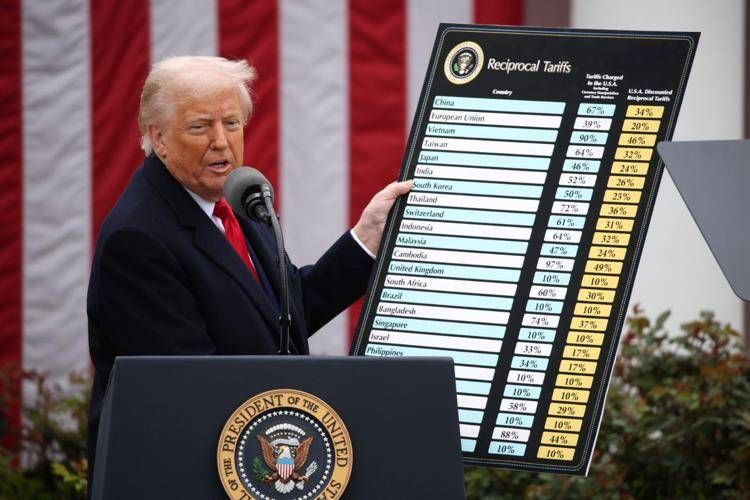
In a 6–3 ruling, the justices say the president exceeded his authority by imposing trade tariffs without congressional approval
The US Supreme Court blocks Trump tariffs under IEEPA in a landmark 6–3 decision that significantly limits presidential authority over trade policy.
The ruling found that President Donald Trump violated federal law by unilaterally imposing tariffs under the International Emergency Economic Powers Act (IEEPA), a 1977 statute designed to regulate certain international transactions during national emergencies.
Six justices voted in favor of striking down the tariffs, while three dissented. Conservative justices Clarence Thomas, Samuel Alito and Brett Kavanaugh voted against the majority opinion.
Trump calls ruling “a disgrace”
Reacting to the decision during a working breakfast with U.S. governors at the White House, Trump described the ruling as “a disgrace,” according to CNN, which cited two sources familiar with his remarks.
One attendee said the president indicated he has a backup plan. Administration officials had reportedly prepared for a potential defeat, reassuring Trump that alternative legal pathways could be used to reintroduce similar tariffs if the Court ruled against him.
According to additional sources, Trump had privately expressed frustration in recent weeks over what he considered delays by the Court in issuing its decision.
The legal reasoning behind the decision
At the center of the dispute was Trump’s reliance on the International Emergency Economic Powers Act. The administration argued that IEEPA granted the president broad authority to regulate economic activity during a national emergency, including the power to impose tariffs.
Writing for the majority, Chief Justice John Roberts — a conservative appointed by President George W. Bush — rejected that interpretation. The opinion stated that IEEPA does not authorize the president to introduce trade tariffs without congressional approval.
The ruling emphasized that when Congress has delegated tariff authority in the past, it has done so explicitly and with clear limitations. The Constitution assigns the power to impose tariffs to the legislative branch, and any delegation of that authority must be narrowly defined.
According to the majority, accepting the administration’s interpretation would represent a sweeping expansion of executive power over trade policy and would upset the constitutional balance between the branches of government.
In addition to Roberts, conservative justices Amy Coney Barrett and Neil Gorsuch — both appointed by Trump — joined the Court’s three liberal justices, Sonia Sotomayor, Elena Kagan and Ketanji Brown Jackson, in concluding that the tariffs imposed under IEEPA were unlawful.
Potential financial consequences
In his dissent, Justice Brett Kavanaugh warned that the ruling could have significant practical implications. One immediate issue is the potential reimbursement of billions of dollars in tariffs already collected, which could carry major consequences for the U.S. Treasury.
Despite the setback, the ruling does not necessarily end the administration’s broader trade agenda. Legal analysts note that Trump could attempt to impose new measures under different statutory authorities, provided they comply with congressional mandates.
For now, however, the decision stands as a clear rebuke: the US Supreme Court blocks Trump tariffs under IEEPA, reinforcing congressional control over tariff policy and setting a precedent that could shape executive trade powers for years to come.
THE LATEST NEWS
[recent_post_slider design=”design-07″ show_author=”false” slider_height=”390″ lazyload=”progressive” limit=”6″ category=”11728″]
(Photo: © AndKronos)