
International-News
Jensen Huang’s Nvidia Exit Exposes a Growing U.S. Tech War With China
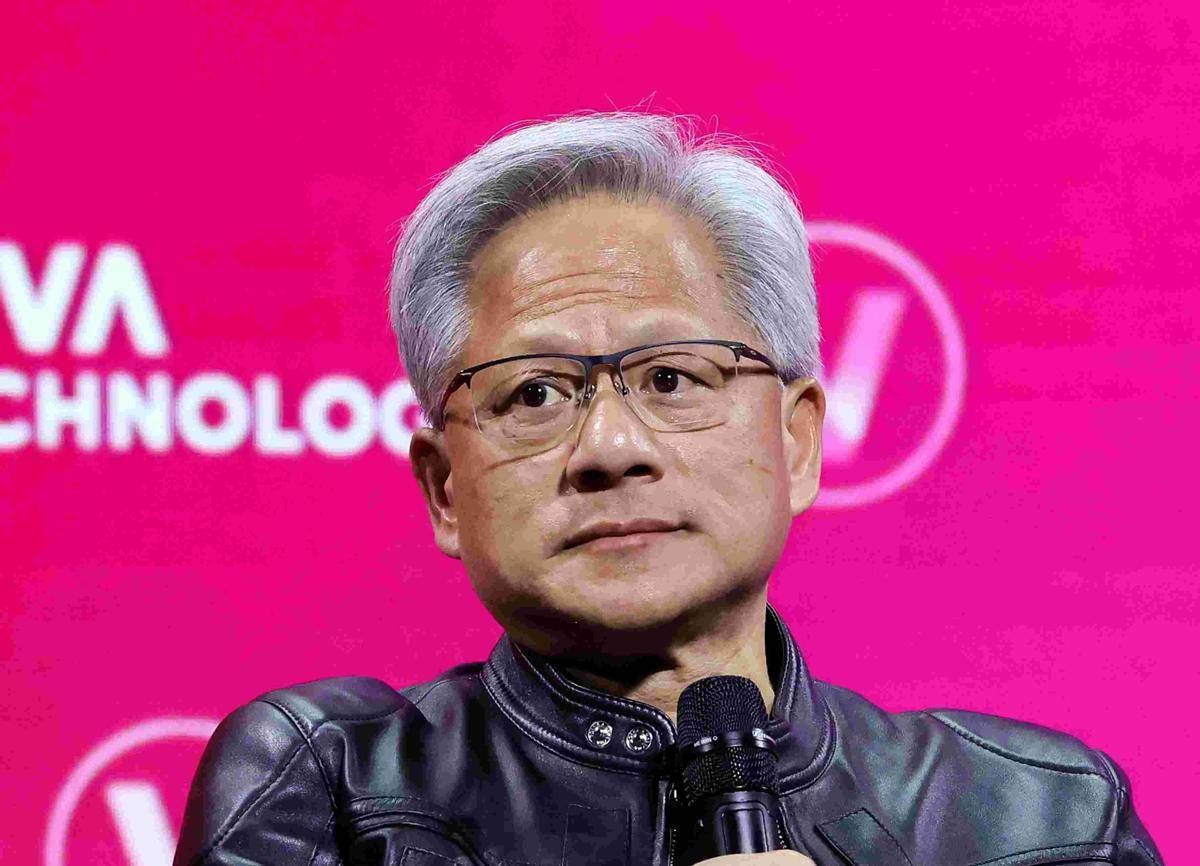
The founder’s sudden departure is giving Nvidia’s rivals and Washington’s China hawks an opening in the battle over advanced AI chips. But weakening the company that helped build America’s technological lead could carry a significant cost
The battle over who controls the future of artificial intelligence is entering a new phase, and Jensen Huang’s departure from Nvidia has given some of its most powerful opponents an opportunity they have been waiting years to seize. The immediate beneficiaries appear to be rival chipmakers AMD and Broadcom, while Washington’s China hawks are closer to securing the export restrictions they have long demanded. But the upheaval raises a more uncomfortable question: can the United States maintain its technological advantage over China by weakening one of the very entrepreneurs who helped create it?
Huang’s resignation, announced on November 12, marks the end of an era for the company he co-founded in 1993. Nvidia’s board appointed chief financial officer Colette Kress as interim CEO while beginning the search for a permanent successor. The decision followed an extraordinary corporate crisis involving reports of two extramarital relationships, one with a woman suspected by U.S. authorities of having links to Chinese intelligence and another with an Nvidia employee. The allegations have also brought renewed scrutiny of the company’s relationship with China and its lobbying against restrictions on advanced chip exports.
Yet the consequences extend well beyond Nvidia’s boardroom. The departure has exposed a collision between corporate interests, national security priorities and the increasingly fierce competition for control of the global AI industry. In Silicon Valley, some competitors see an opening. In Washington, a group of officials and advisers who have spent years arguing against the sale of advanced American processors to China may finally be gaining the upper hand.
Washington’s China hawks see an opportunity
Reed Albergotti, writing in Semafor, describes the moment as a potential victory for the so-called China hawks: officials, analysts, academics and political advisers who believe that allowing Beijing access to advanced American processors directly strengthens its principal strategic rival.
Huang had become one of their most outspoken adversaries. He repeatedly argued that restricting exports to China would ultimately damage American competitiveness by encouraging Chinese companies to develop domestic alternatives and reducing the global reach of U.S. technology.
In a podcast interview, he went further, describing the label of China hawk as a badge of shame and questioning the patriotism of those who embraced it.
His remarks left little doubt about the depth of the disagreement. For Huang, maintaining access to the Chinese market was not simply a commercial calculation. It was part of a broader strategy to ensure that American technology remained the global standard.
Eric Sayers, managing director of Beacon Global Strategies and a former congressional defense staffer, offered a pointed response on X: China hawks, he wrote, are patient and have long memories.
Among the influential figures associated with this policy camp are Ivan Kanapathy, now a senior director for Asia at the National Security Council, Landon Heid, an NSC staffer, and Tarun Chhabra, a former senior national security official who has since joined Anthropic. Their presence reflects how deeply the dispute over semiconductor exports has penetrated the national security establishment.
Huang’s departure removes one of the most influential corporate voices in Washington’s debate over technology exports, a businessman who had enjoyed direct access to President Donald Trump and consistently pressed the administration to preserve Nvidia’s ability to sell into China.
Anthropic represents almost the opposite position. Chief executive Dario Amodei has advocated a considerably tougher approach to advanced chip exports, comparing the sale of powerful processors to China with selling nuclear weapons to North Korea. The company has also accused Chinese AI developers of using its technology to train their own models.
The export restrictions that could reshape the AI industry
The political shift could soon translate into concrete regulatory changes.
According to The Information, the Commerce Department is finalizing a rule designed to prevent Chinese AI companies from remotely accessing advanced American processors installed in data centers located in other countries.
The proposed restrictions would extend existing semiconductor-related controls to seven additional nations: Singapore, Malaysia, Thailand, Indonesia, Brazil, Norway and South Africa. The measure is intended to close a potential loophole through which Chinese companies could obtain computing power without directly importing restricted American chips.
The regulation is still being finalized, with the Commerce Department consulting other government agencies. It could be announced as soon as November.
This is precisely the kind of measure Nvidia had opposed through its lobbying efforts. The company had argued against restrictions that could limit its access to international customers and undermine its position in one of the world’s most important technology markets.
With Huang no longer leading the company, Washington’s China hawks may face considerably less resistance from one of the most powerful figures in the semiconductor industry.
There is also an industrial dimension to the political confrontation. According to Semafor, some Silicon Valley executives are privately welcoming the possibility that processors previously destined for Chinese customers could instead become available to American companies.
In an industry where access to computing power remains a major constraint, additional supplies could help accelerate model training and the development of new AI products. OpenAI, Anthropic and other American laboratories could potentially benefit from a larger share of the available hardware.
Wall Street turns Nvidia’s crisis into an opportunity
The market reaction has been immediate, although the scale of the sell-off has fluctuated throughout the trading session.
Nvidia shares fell as much as 14% at the opening bell on November 12 before recovering a substantial portion of their losses, eventually closing down 4.3%. The company had shed approximately $550 billion in market value over the week, according to Reuters.
For competitors, the disruption has created an opening. AMD and Broadcom moved in the opposite direction, gaining approximately 5.9% and 5.5%, respectively, as investors considered whether the leadership crisis could accelerate a shift in demand toward alternative chip suppliers.
The pressure also extended to companies whose businesses are closely connected to Nvidia’s financial and technological ecosystem. CoreWeave, a major provider of cloud infrastructure for AI, suffered losses, while Nebius fell sharply amid concerns that included disappointing revenue forecasts. Oracle, Micron and Marvell were also among the companies facing downward pressure.
The distinction is important: investors are not necessarily abandoning the AI trade. They are reassessing how much of its future depends on Nvidia and on the leadership of the man who built it.
China could emerge as an unexpected beneficiary
There is, however, a contradiction at the heart of Washington’s strategy.
Restricting China’s access to advanced American processors may slow the development of its AI industry in the short term. But weakening Nvidia and tightening the supply of foreign technology could also accelerate Beijing’s efforts to build a domestic semiconductor industry capable of replacing American products.
The Chinese market has already provided an indication of that possibility. Shares in domestic GPU manufacturers Moore Threads, MetaX and Cambricon rose sharply, with gains approaching 10% in Thursday’s trading. Cambricon advanced 9.8%, while Moore Threads and MetaX also recorded substantial increases.
The rally reflects investor expectations that tighter American restrictions could create additional opportunities for Chinese chip designers. Beijing has made technological self-sufficiency a strategic priority, and the difficulties facing Nvidia could reinforce the case for investing in domestic alternatives.
That does not mean Chinese manufacturers are ready to match Nvidia across the entire range of its technology. But the political and commercial pressure surrounding American exports could give them an incentive, and a market opportunity, to close the gap.
Can Nvidia survive without its founder?
The question now facing the industry is not simply who will benefit from Huang’s departure, but whether Nvidia can preserve the model that made it dominant.
Huang did considerably more than build a successful semiconductor company. He created an ecosystem in which Nvidia became a supplier, investor, financial partner and strategic reference point for businesses across the AI industry. Its relationships extend from major technology companies and cloud providers to the laboratories developing the next generation of artificial intelligence.
That position was closely connected to his personal leadership style. Huang maintained an unusually hands-on management structure, with dozens of executives reporting directly to him. He also played a central role in negotiating complex commercial and financial relationships that connected Nvidia with customers, suppliers and AI developers.
The company had no publicly identified immediate successor when the crisis erupted. Colette Kress, who joined Nvidia in 2013 and has served as its chief financial officer, is now responsible for ensuring operational continuity while the board searches for a permanent chief executive.
Her appointment could bring greater financial discipline and management stability. But replacing Huang’s strategic influence is a different challenge. His ability to anticipate emerging markets, bring together competing interests and commit Nvidia to technological opportunities before they became mainstream was central to the company’s rise.
The board has also announced that its investigation into reports that Huang was targeted by a foreign intelligence effort will continue. When it first disclosed the inquiry on November 8, Nvidia said it had no reason to believe that national security or company secrets had been compromised.
That distinction remains important: allegations of espionage have not established that sensitive information was compromised or that Nvidia knowingly transferred restricted technology to China.
The United States may succeed in slowing Beijing’s access to its most advanced processors. It may strengthen domestic AI laboratories, impose tighter controls on strategic technologies and create opportunities for Nvidia’s competitors.
But American technological leadership was not built exclusively through restrictions imposed on rivals. It also came from the ability of entrepreneurs such as Huang to imagine markets that did not yet exist, develop the technologies to serve them and turn an ambitious vision into an industrial reality.
That is the contradiction behind the celebrations in parts of Silicon Valley and Washington. The departure of one of America’s most influential technology entrepreneurs may make it easier to contain China. It could also weaken one of the forces that made the United States so difficult to catch in the first place.
(Photo: © AndKronos)




You must be logged in to post a comment Login