International-News
“Putin Can Kill Anyone”: Pussy Riot’s Warning to Europe
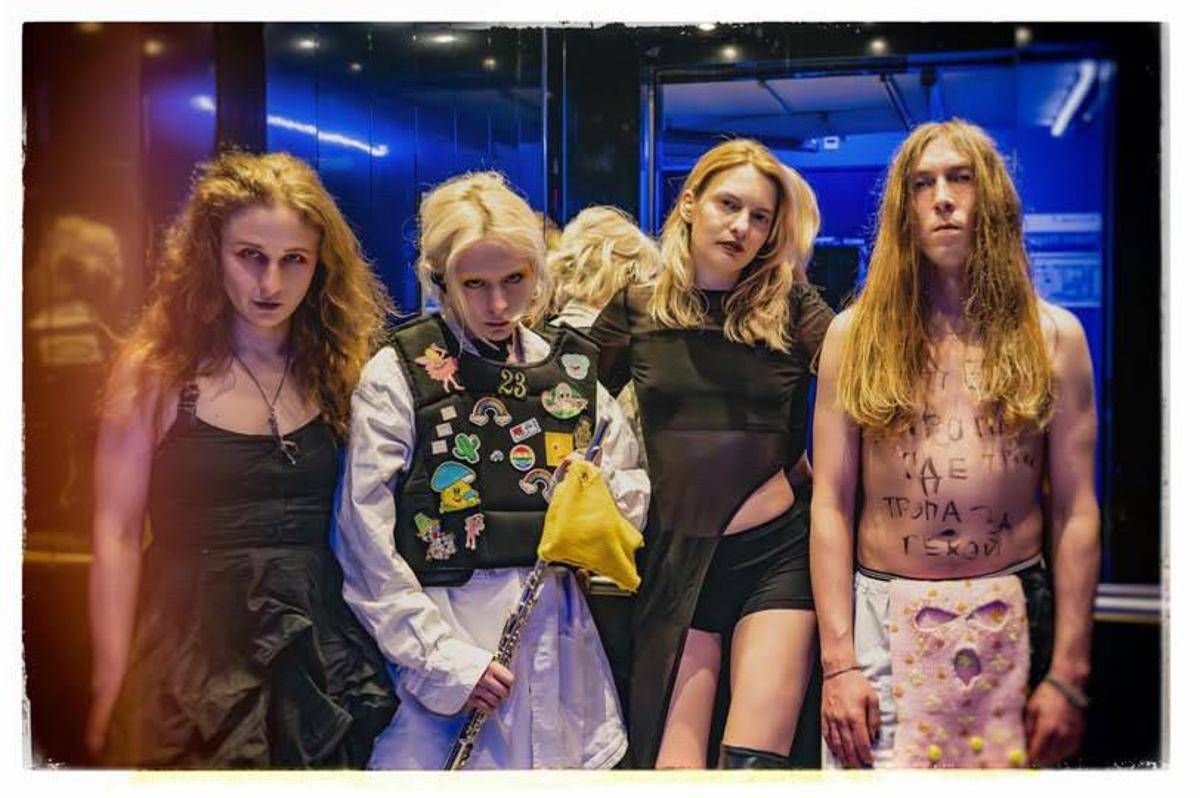
In an interview with Adnkronos ahead of the Italian return of Riot Days, Pussy Riot members Masha Alyokhina, Eric Breitenbach, Alina Petrova and Taso Pletner reflect on Alexei Navalny’s death, Russia’s war against Ukraine, the rise of authoritarian politics and the personal cost of dissent.
MILAN — Alexei Navalny’s death did more than remove Vladimir Putin’s most prominent political opponent. For Masha Alyokhina, it shattered a lingering assumption shared by many inside and outside Russia: that international visibility could still offer some degree of protection from the Kremlin.
“Putin has made it absolutely clear that he can kill the most protected, most famous person in front of everyone and nobody does anything,” the Pussy Riot co-founder told Adnkronos ahead of the Italian return of Riot Days, the multimedia stage production that will arrive at Arci Bellezza in Milan on Feb. 17, 2027, Locomotiv in Bologna on Feb. 18 and Largo Venue in Rome on Feb. 19.
The remark was not delivered as political rhetoric. It was presented as a conclusion.
For Alyokhina and her fellow performers, the death of Navalny marked the end of any remaining illusion that pressure from Western governments still imposes meaningful limits on Putin’s actions. It is a belief that now sits at the center of Riot Days, a production that has transformed dramatically since Russia’s full-scale invasion of Ukraine and that has become as much a chronicle of political repression as a theatrical performance.
Speaking alongside Eric Breitenbach, Alina Petrova and Taso Pletner, Alyokhina discussed war, exile, democratic fragility, artistic responsibility and the reasons why Pussy Riot believes Europe’s political future is more closely connected to Russia’s trajectory than many are willing to admit.
From Protest Theater to a Chronicle of War
When Riot Days premiered in 2017, it was largely rooted in Alyokhina’s memoir of the same name.
Created with producer Alexander Cheparukhin, the production blended live music, documentary material, performance art and archival footage to recount the story of Pussy Riot’s rise to international attention, the Punk Prayer protest inside Moscow’s Cathedral of Christ the Savior, Alyokhina’s imprisonment and the legal campaign that followed.
That version of the show no longer exists.
According to Alyokhina, roughly half of the original production was removed last year and replaced with material drawn from her second book, Political Girl.
The decision reflected a broader transformation in how the collective viewed its own story.
Originally, Riot Days was primarily about Pussy Riot.
Today, it is also about the political path that led Russia to war.
“The reason is pretty clear,” Alyokhina said. “The second book covers the period from 2014 until 2022, until the full-scale invasion. We wanted to show what we call the Road to Hell.”
In the collective’s telling, that road was not shaped by a single event. It emerged through a gradual accumulation of political developments: increasing repression, the first invasion of Ukraine, the persecution of opposition figures, the imprisonment of critics and the steady concentration of power around Putin.
“It is basically a story of repression,” Alyokhina said. “A mosaic of many things that ultimately led to the war.”
The war itself altered her life in a more direct way.
“It brought me to leave Russia.”
Navalny and the End of Deterrence
If the war reshaped Riot Days, Navalny’s death reinforced the message the production now seeks to convey.
Alyokhina recalled repeated warnings from Western leaders that severe consequences would follow if the opposition figure were killed.
Instead, she argues, those warnings dissolved into inaction.
“It was a punch in the stomach,” she said. “People said that if Putin killed Navalny there would be consequences unlike anything we’d ever seen before. But there were no consequences.”
From her perspective, the implications extended far beyond one man.
The lesson was that political prominence provides no guarantee of safety.
If Navalny could die, anyone could.
The statement was one of several moments during the conversation in which Alyokhina appeared less interested in criticizing the Kremlin itself than in highlighting what she sees as a persistent unwillingness among democratic governments to recognize the realities they are confronting.
‘It Is the Soviet Union’
Asked how much of Soviet Russia remains visible in the country today, Alyokhina’s answer was strikingly brief.
“It is the Soviet Union,” she said. “Putin continues that tradition.”
The comment reflected a broader theme running throughout the discussion.
For Alyokhina, the current political system did not emerge suddenly with the invasion of Ukraine, nor can it be explained solely through contemporary events. Instead, she sees today’s Russia as the continuation of institutional and political patterns that long predate the current war.
That perspective also explains why the revised version of Riot Days spends so much time examining developments that occurred years before February 2022.
The production is designed to show continuity rather than rupture, tracing connections between earlier episodes of repression and the present moment.
A Different Front in the Conflict
The conversation frequently returned to Europe.
While Russia’s war against Ukraine remains the most visible manifestation of Kremlin power, Alyokhina argues that Moscow’s influence extends far beyond military operations.
“Putin is invading Ukraine with the army and bombs,” she said. “But in many European countries his state uses soft power.”
According to Alyokhina, vast sums generated from oil and gas revenues have been invested over many years in ways intended to influence political systems across Europe.
“It is dangerous,” she said. “This is not something new. It has been happening for a long time.”
Speaking specifically about Italy, she pointed to Alexander Dugin, whom she described as a central ideological figure behind Putin’s worldview and the theories used to justify Russian military campaigns and occupations.
The concern expressed by Alyokhina is not merely geopolitical.
It is cultural and political.
Her argument is that societies often become vulnerable long before they recognize a threat as a threat.
Beyond the Left-Right Divide
While Alyokhina focused on authoritarian influence, Eric Breitenbach approached Europe’s political tensions from a different direction.
“I think right and left are simply another way to divide people,” he said.
Breitenbach emphasized that Pussy Riot is not interested in speaking only to audiences that already agree with its political positions.
People with opposing views, he argued, should still come to the performances, engage with the material and draw their own conclusions.
“Listen to us and see what we have to say,” he said. “Maybe you’ll like it. Maybe you won’t. But you can’t know until you come.”
The comment underscored a recurring theme throughout the interview: the belief that democratic societies require disagreement and debate, not isolation within ideological camps.
Freedom Is Never Permanent
The question of freedom occupies a central role in Riot Days and in the thinking of the people who perform it.
At the end of every show, audiences are asked a simple question: “Are you free?”
For Alina Petrova, the question remains urgent precisely because freedom can disappear more quickly than people assume.
“Freedom can be taken away very fast,” she said.
Petrova rejects the idea that authoritarianism belongs exclusively to particular countries or cultures. Historical examples from Germany, Italy, Spain and Russia demonstrate, she argues, how rapidly societies can move toward repression under the right conditions.
The lesson she draws is not ideological but civic.
Democracy requires participation.
When citizens withdraw from public life, others fill the vacuum.
“Being citizens of any country is work for everyone,” she said.
The Silence of Artists
As wars continue to shape global politics, members of the collective expressed concern about what they view as growing reluctance among artists to address major international crises.
Petrova does not believe art can exist outside politics.
“Art is inevitably political,” she said.
Ignoring political realities, she argues, is itself a form of political behavior.
Her comments extended beyond Gaza to include Iran and other conflicts that receive less sustained international attention despite their significance.
“There are many wars around us,” she said.
For Petrova, those conflicts are not distant events happening elsewhere.
They influence Europe, shape migration patterns, alter political debates and affect the societies in which audiences live.
“They are not far away,” she said. “They are here.”
The Personal Cost of Resistance
The most emotional moments of the conversation did not concern Putin, war or ideology.
They concerned family.
Asked whether she would change anything about her decisions or activism, Petrova answered immediately.
“No.”
She said she remains convinced she did the right thing by speaking publicly against her government and accepting the consequences of that choice.
Yet conviction has not eliminated the pain that followed.
The possibility of never seeing her parents again remains one of the hardest realities of exile.
“I am deeply sorry that it is almost impossible for me to see them,” she said. “I am really afraid I will never see them again.”
The remark cut through the broader political discussion.
For all the talk of governments, wars and movements, it served as a reminder that political repression is often experienced through intensely personal losses.
“Our reality is divided in two,” Petrova said. “Half of it will be dead forever.”
More Than a Punk Show
The interview took place as the world approaches the 50th anniversary of punk, a milestone that might appear naturally connected to Pussy Riot.
The group itself sees the relationship differently.
Breitenbach readily acknowledged punk’s influence on his life and artistic development. Yet he stressed that Riot Days cannot be understood as a traditional punk concert.
The production combines documentary storytelling, archival imagery, theater and live performance in a format that deliberately resists easy categorization.
Petrova went even further.
“I don’t think Pussy Riot is a punk group,” she said.
Instead, she describes the collective as a group of political activists who also make music.
For her, the label matters less than the capacity of art to influence public opinion and communicate ideas in ways conventional political language often cannot.
“Artists can change things,” she said.
A Question Europe Cannot Ignore
Nearly a decade after Riot Days first appeared on stage, the production continues to evolve because the events surrounding it continue to evolve.
What began as the story of Pussy Riot’s confrontation with the Russian state has become a broader account of repression, war, political responsibility and democratic fragility.
The final question posed during every performance remains deceptively simple.
“Are you free?”
For Alyokhina, Petrova, Breitenbach and Pletner, the answer cannot be taken for granted.
As they prepare to bring the production back to Milan, Bologna and Rome, they insist that the show is not primarily about Russia’s past. It is about choices being made in the present.
And about whether citizens recognize the value of their freedoms before discovering how easily they can be lost.
Pletner offered the simplest invitation of the evening.
“Come listen to our story,” he said. “And tell us yours.”
(Photo: © AndKronos)