
International-News
Russian Drone Incursion Into Poland Raises Stakes Along NATO’s Border
Warsaw says it authorized a shootdown but held fire to avoid civilian casualties. A senior Polish official believes the breach was deliberate, as NATO prepares to reinforce surveillance after a separate Russian missile incursion
A Russian drone crossed into Polish airspace during an overnight assault on western Ukraine, prompting Warsaw to activate its air defenses and authorize an interception before deciding not to fire. The decision was made after the aircraft changed course and headed east, but the incident has added to mounting concern in NATO that Russia’s war is increasingly threatening the alliance’s eastern frontier.
Polish Deputy Defense Minister Paweł Zalewski said Tuesday that the incursion was unlikely to have been accidental. “It is difficult to imagine that this was accidental. We assume it was an intentional action,” he told broadcaster RMF FM, according to Polish Radio.
The drone entered Polish airspace near Dorohusk, in the Lublin region, during Russia’s attack on Ukraine late Monday. According to details reported by RMF24 and cited by Ukrinform, it remained over Poland for several minutes and was tracked by three air defense systems. The aircraft was reportedly equipped with cameras and other reconnaissance equipment, although Polish officials have not confirmed whether it was conducting a surveillance mission or carrying weapons.
Poland’s Operational Command said its radar systems had followed the object continuously and that authorization to destroy it had been granted. The military ultimately refrained from using weapons because the drone had turned east and an interception could have endangered civilians or caused damage on the ground.
The decision comes at a particularly sensitive moment for Warsaw. Just days earlier, three Russian Kh-101 cruise missiles had entered Polish airspace during another attack on Ukraine. NATO has since agreed to make an airborne early-warning aircraft available to Poland, while considering further measures to reinforce the country’s defenses.
NATO prepares to strengthen Poland’s air defenses
The latest drone incursion is the second major airspace incident involving Poland in a matter of days. On Nov. 20, three Russian Kh-101 missiles entered Polish territory, with prosecutors subsequently confirming that the weapons had landed at three locations in the country’s southeast.
The episode prompted an urgent NATO meeting in Brussels on Monday. Following the discussions, Zalewski announced that the alliance would provide Poland with an AWACS surveillance aircraft to improve its ability to detect and track airborne threats.
The aircraft, equipped with a large radar system, can build a shared picture of activity across a wide area and help coordinate allied fighter jets. NATO has 14 AWACS aircraft, normally based at Geilenkirchen in Germany, which have been used to monitor the alliance’s eastern flank since Russia launched its full-scale invasion of Ukraine in 2022.
Zalewski said further assistance was being considered, including additional combat aircraft. He also explained why Polish and allied pilots had not fired at the missiles during Friday’s incident: poor weather had prevented the required visual identification of the targets under peacetime NATO procedures.
The Polish government has sought to strengthen the rules governing engagement with potential threats. Zalewski said pilots operating in certain sectors had already been given advance authorization to shoot down missiles within their operational range.
The distinction between the two recent incidents is significant. In the latest case, the Polish military said it had decided against firing because of the risk to civilians after the drone changed direction. The broader question facing Warsaw and NATO is how to respond when Russian weapons cross into allied territory without turning an airspace violation into a direct military confrontation.
Zaporizhzhia death toll rises as rescuers search the rubble
While the airspace incidents have raised concerns beyond Ukraine’s borders, Russian strikes have continued to hit populated areas across the country.
In Zaporizhzhia, two people were killed and at least 40 injured in an overnight attack that partially destroyed a five-story apartment building in the city’s Kosmichnyi district. Some reports put the number of wounded at 44, as emergency crews continued searching the damaged structure for people who might still be trapped beneath the rubble.
Regional authorities said a private home was also destroyed. Other apartment buildings, houses, vehicles and transport infrastructure were damaged. Among the injured are several children, including an infant, a six-year-old boy and a 16-year-old girl. One woman was reported to be in serious condition with blast injuries and a traumatic brain injury.
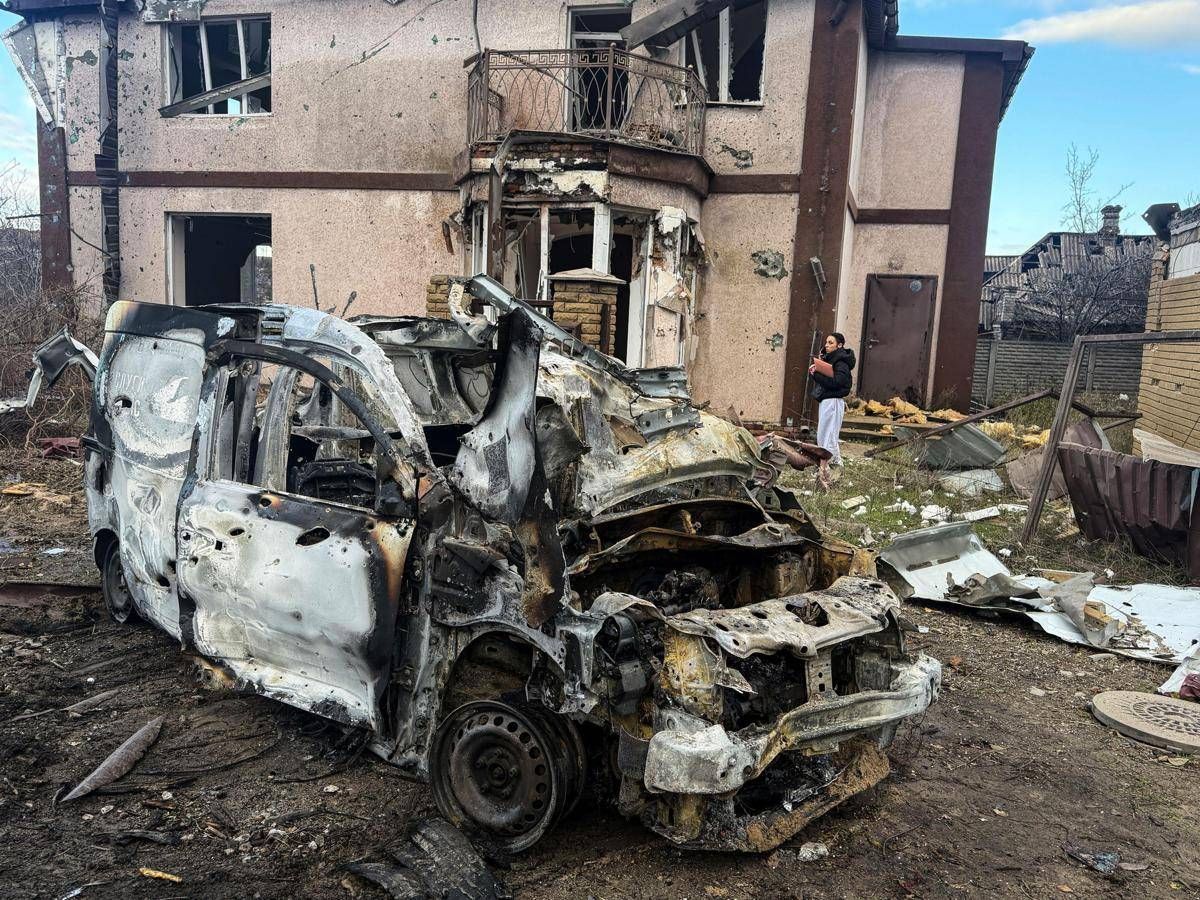
Images released after the attack showed a large section of the apartment building torn open, exposing parts of the interior. The full extent of the damage was still being assessed as rescue operations continued.
Energy infrastructure hit in Vinnytsia and Zhytomyr
Further attacks struck civilian and energy infrastructure in central and northern Ukraine.
In Vinnytsia, four men were injured when Russian strikes damaged a civilian business and an energy facility, according to regional authorities. Three received medical assistance at the scene, while another was taken to hospital.
The attack also damaged two public transport stops, four cars, a trolleybus and nearby buildings. Mayor Serhii Morhunov said the city had come under a second attack, with a strike hitting critical infrastructure.
In the Zhytomyr region, Russian attacks damaged a Nova Poshta branch and nearby commercial warehouses in Korosten, triggering a large fire that emergency crews later brought under control. Two businesses in Zhytomyr were also hit. A repair workshop, an administrative building and 36 civilian vehicles sustained damage, as did residential buildings and educational institutions. An energy infrastructure facility in the district was also targeted.
No deaths or physical injuries were reported in the Zhytomyr region, although six people experienced acute stress reactions and did not require hospitalization.
Ukraine says 73 of 96 Russian drones were neutralized
The Ukrainian Air Force said Russia launched 96 drones against the country between 6 p.m. Monday and 8 a.m. Tuesday. The weapons included Shahed attack drones, 64 of them jet-powered, as well as Gerbera drones and Parody decoys.
Ukraine’s military said 73 drones had been shot down or suppressed by 8 a.m. The defensive effort involved fighter aircraft, anti-aircraft missile units, electronic warfare systems, unmanned systems units and mobile air defense teams.
Despite the interceptions, drone strikes were recorded at 13 locations, while debris from downed aircraft fell at two other sites. The attack was still underway when the Ukrainian Air Force released its preliminary figures.
The drones were launched from several directions, including Russia’s Oryol, Bryansk and Primorsko-Akhtarsk regions, as well as from occupied areas of Donetsk and Crimea.
Moscow claims nearly 700 Ukrainian drones were intercepted
Russia, meanwhile, reported an exceptionally large Ukrainian drone assault overnight. The Russian Defense Ministry said its air defenses had intercepted and destroyed 699 Ukrainian unmanned aircraft over the Bryansk, Belgorod, Kaluga, Oryol and Smolensk regions, the Moscow region, Crimea and the Black Sea.
Moscow Mayor Sergei Sobyanin said 355 drones had been heading toward the capital between Monday evening and Tuesday morning. Most were reportedly intercepted at a distance, while 63 were destroyed as they approached Moscow.
The threat led to temporary restrictions at the Vnukovo and Sheremetyevo airports, where flights were handled only with special authorization for several hours. Restrictions were also imposed at Kaluga’s Grabtsevo airport.
Russian authorities reported no deaths or injuries from the interceptions. The figures released by Moscow, like the Ukrainian military’s account of the overnight assault, could not be independently verified.
The scale of the competing claims illustrates how drones have become a central feature of the conflict far beyond the front line. Ukraine’s overnight barrage reached deep into Russian territory, while Russia’s attacks struck residential buildings, businesses and energy facilities across Ukraine. Poland’s latest airspace incident shows how even a single unmanned aircraft can turn that expanding battlefield into an immediate security concern for NATO.
(Photo: © AndKronos)







You must be logged in to post a comment Login